Functions
Dialogue contains a bunch of functions to help you use dialogue in any way you need.
Adjust Player Transform
Adjusts the player's position in one-on-one dialogues.

Can Skip Dialogue
Returns whether skipping is allowed for the current dialogue.
This function determines if the dialogue as a whole permits skipping, regardless of the current line.
It is commonly used to:
- Globally disable skipping for important conversations
- Control skip behavior for cinematic or story-critical dialogue
- Gate UI controls such as Skip or Fast Forward
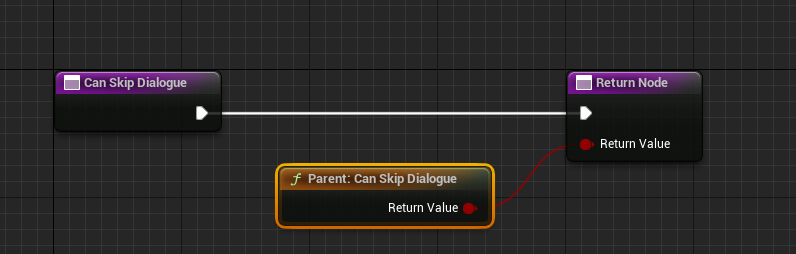
Output
| Name | Type | Description |
|---|---|---|
| Return Value | bool | Whether dialogue skipping is allowed. |
This function is evaluated in addition to per-line skip checks.
For a line to be skippable:
CanSkipDialoguemust returntrueCanSkipCurrentLinemust also returntrue
Get Speaker Head Location
Returns the location of the actor's head, where the dialogue camera will aim.

Inputs
| Name | Type | Description |
|---|---|---|
| Actor | AActor* | The actor whose head location is being retrieved. |
Output
| Name | Type | Description |
|---|---|---|
| - | FVector | The location of the actor's head. |
Tick Dialogue
Called every tick to update the dialogue.

Inputs
| Name | Type | Description |
|---|---|---|
| DeltaTime | float | The time elapsed since the last frame. |
Link Speaker Avatar
Links a dialogue speaker to a Speaker Avatar actor.
Narrative uses Speaker Avatars to determine:
- Where to point the camera
- Which actor should play animations
- Who dialogue lines are associated with in the world
This function attempts to resolve the correct avatar for a speaker using the following order:
- Spawn an actor if the speaker has an
AvatarActorClassset - Find an existing actor in the world with the speaker’s
SpeakerIDset as a tag - Fallback behavior
- NPC speakers →
DefaultNPCAvatar - Player speakers → The player’s Pawn
- NPC speakers →
If none of these methods succeed, no avatar will be linked.
If this default behavior does not suit your game, you can override this function in Blueprint or C++ to implement custom avatar resolution.
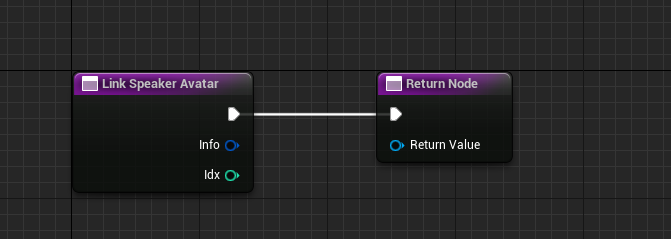
Inputs
| Name | Type | Description |
|---|---|---|
| Info | FSpeakerInfo | Information about the speaker being linked, including ID and avatar data. |
| Idx | int32 | The index of the speaker within the dialogue’s speaker list. |
Output
| Name | Type | Description |
|---|---|---|
| Return Value | AActor* | The actor linked as the Speaker Avatar, or null if none. |
Speaker Avatars are cached after linking and reused throughout the dialogue.
Overriding this function allows for:
- Custom spawn logic
- Dynamic actor selection
- Integration with existing NPC systems
Destroy Speaker Avatar
Removes a speaker avatar from the world.

Inputs
| Name | Type | Description |
|---|---|---|
| Info | FSpeakerInfo | The speaker information. |
| SpeakerAvatar | AActor* | The speaker avatar to destroy. |
Play Dialogue Animation
Plays a dialogue animation on the given speaker.

Inputs
| Name | Type | Description |
|---|---|---|
| Node | UDialogueNode* | The dialogue node. |
| Line | FDialogueLine | The dialogue line being spoken. |
| Speaker | AActor* | The speaker's avatar. |
| Listener | AActor* | The listener's avatar. |
Stop Dialogue Animation
Stops any currently playing dialogue animations.

Play Dialogue Sound
Plays a dialogue sound.

Inputs
| Name | Type | Description |
|---|---|---|
| Line | FDialogueLine | The dialogue line being spoken. |
| Speaker | AActor* | The speaker's avatar. |
| Listener | AActor* | The listener's avatar. |
Play Dialogue Node
Plays a dialogue node with audio, animations, and camera updates.

Inputs
| Name | Type | Description |
|---|---|---|
| Node | UDialogueNode* | The dialogue node. |
| Line | FDialogueLine | The dialogue line being spoken. |
| Speaker | FSpeakerInfo | The speaker information. |
| SpeakerActor | AActor* | The speaker's avatar. |
| ListenerActor | AActor* | The listener's avatar. |
Finish Dialogue Node
Stops the dialogue node, ending any playing audio or animations.

Inputs
| Name | Type | Description |
|---|---|---|
| Node | UDialogueNode* | The dialogue node. |
| Line | FDialogueLine | The dialogue line being spoken. |
| Speaker | FSpeakerInfo | The speaker information. |
| SpeakerActor | AActor* | The speaker's avatar. |
| ListenerActor | AActor* | The listener's avatar. |
Play NPC Dialogue
Plays an NPC's dialogue with audio, animations, and cinematic shots.

Inputs
| Name | Type | Description |
|---|---|---|
| NPCReply | UDialogueNode_NPC* | The NPC's dialogue node. |
| Line | FDialogueLine | The dialogue line being spoken. |
| Speaker | FSpeakerInfo | The speaker information. |
Play Player Dialogue
Plays the player's dialogue with audio, animations, and cinematic shots.

Inputs
| Name | Type | Description |
|---|---|---|
| PlayerReply | UDialogueNode_Player* | The player's dialogue node. |
| Line | FDialogueLine | The dialogue line being spoken. |
Get Line Duration
Returns how long the dialogue system should wait before moving to the next line.

Inputs
| Name | Type | Description |
|---|---|---|
| Node | UDialogueNode* | The dialogue node. |
| Line | FDialogueLine | The dialogue line being spoken. |
Output
| Name | Type | Description |
|---|---|---|
| - | float | The duration of the line in seconds. |
Get String Variable
Resolves a variable name within a dialogue line.

Inputs
| Name | Type | Description |
|---|---|---|
| Node | UDialogueNode* | The dialogue node. |
| Line | FDialogueLine | The dialogue line being spoken. |
| VariableName | FString | The name of the variable to resolve. |
Output
| Name | Type | Description |
|---|---|---|
| - | FString | The resolved string value. |